- 01 The scale
- 02 The machine that hides the machine
- 03 We are paying them
- 04 The Canaport tax break
- 05 The Crown land bargain
- 06 The cloned forest
- 07 The chemical and the messenger
- 08 How competitors disappear
- 09 The rails
- 10 The things we are not allowed to use
- 11 The refinery and the exits
- 12 Retail and the unavoidable
- 13 The human cost and the churn
- 14 The premier who actually worked there
- 15 The reach
Reports · New Brunswick
The Company Province
A sourced investigation into the structure that holds New Brunswick, the public record behind it, and what the province could build instead.
Read the investigation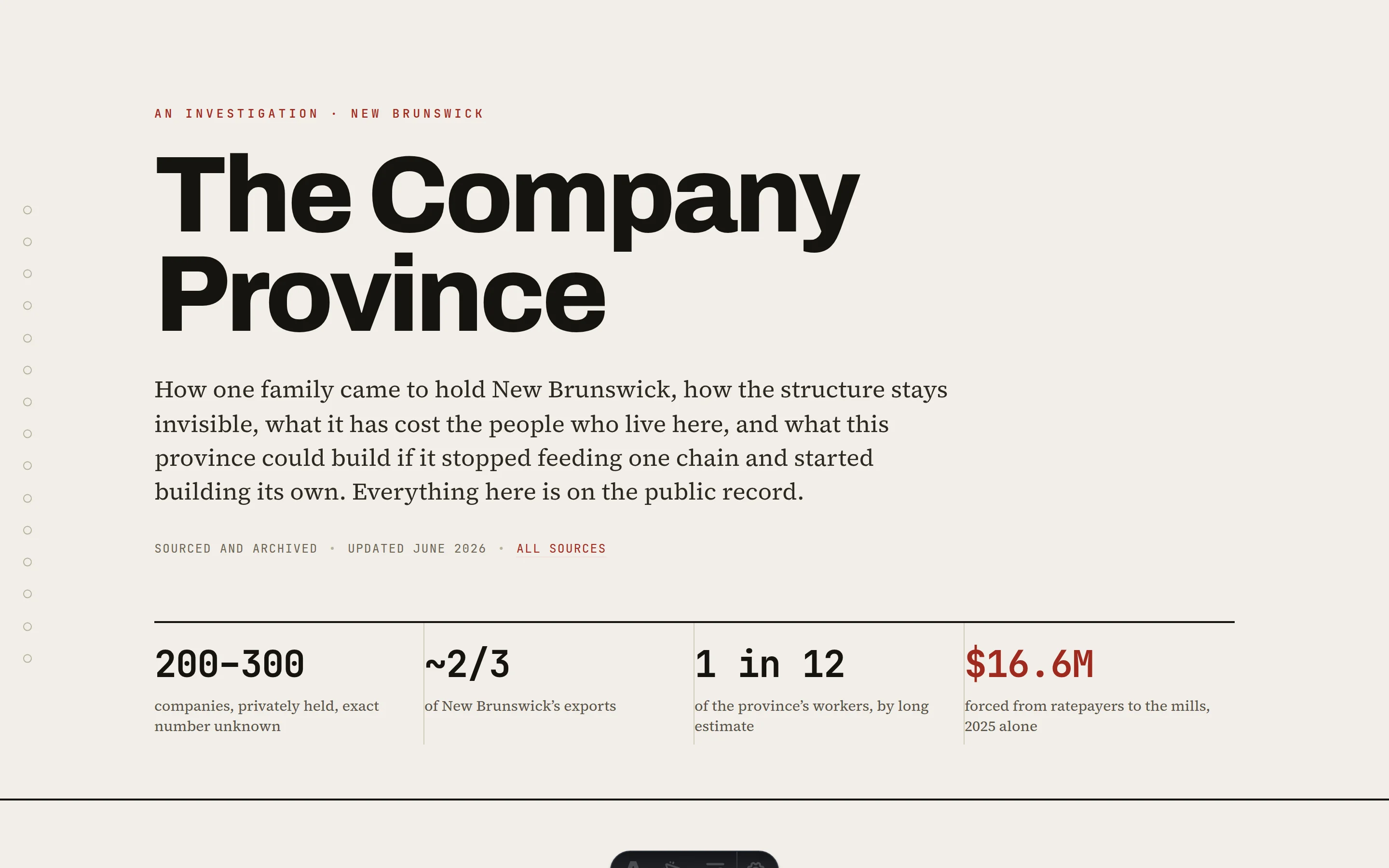
In 1969 a federal committee called New Brunswick a “journalistic disaster area.” In 2006 a Senate committee said the dominance of a single family here was something it could not find anywhere else in the developed world. Two inquiries, four decades apart, reaching for the same word: unprecedented. Both times, almost nothing changed.
This lays the documented picture out in one place: what the family controls, how the structure is built to stay invisible, the specific mechanisms by which a province this rich in resources stays this poor, and what could replace it. Almost everything here comes from the public record: court filings, government documents, auditor reports, a U.S. federal trade investigation, and the work of reporters who kept digging despite the obvious difficulty of covering a family that owned most of the local press. Where something is testimony rather than proven fact, it is labelled as such. The documented version is more than damning enough. It does not need exaggeration, and exaggeration is exactly what gets people with fewer lawyers sued by people with more.
Chapter 01 · The shape of it
The scale
The Irving group is not one company. It is somewhere between 200 and 300 companies, and because they are all privately held, nobody outside the family knows the exact number.1

After a long and expensive restructuring completed around 2012, the empire built by K.C. Irving split among his three sons’ branches into three main pillars: J.D. Irving Ltd., which holds forestry, sawmills, pulp and paper, tissue, rail, trucking, food and building supplies; Irving Oil, which holds Canada’s largest refinery, roughly 900 service stations and the Canaport terminal; and Ocean Capital, which holds real estate and broadcasting.1
The land
- ~3.2M acres of woodlands
- Crown timber, public land
The forest is owned. The crude for the refinery is imported.
Produce
- Forestry, sawmills, pulp & paper
- Irving Paper (Saint John)
- Irving Tissue (Royale, Majesta)
- Cavendish Farms
- Saint John refinery 320,000 bbl/day
Move
- NB Southern Railway
- Sunbury, RST, Midland, Kent Line
- Canaport terminal
Sell
- ~900 service stations
- Kent Building Supplies
Keep
- Offshore holdings · Bermuda trusts since 1976
Each stage buys from the one above it. The margin never leaves the chain, and what reaches the offshore holdings is what the rest of the province never sees. Irving Shipbuilding sits in a separate family branch.
The weight of it is hard to overstate. The family’s companies produce roughly two-thirds of New Brunswick’s exports and have long been estimated to employ about one in twelve of the province’s workers.2 The defining feature is vertical integration: K.C. built a system where each company buys from another Irving company, so profit stays inside the chain from the tree or the barrel all the way to the retail shelf. It is genuinely impressive business engineering. It is also why so little of the money circulates out into the wider provincial economy.
And here is the backdrop that should stop everyone cold. Despite hosting one of the most concentrated private fortunes in the country, New Brunswick remains one of Canada’s poorest provinces. When investigative reporter Bruce Livesey compared the province’s social outcomes to the rest of the country for his award-winning House of Irving series, what he found was not prosperity in the shadow of all that wealth. It was the opposite: among the lowest median incomes, high out-migration, high poverty.3 The wealth is real. It has never translated into broad prosperity for the place that produced it.
Chapter 02 · How it stays invisible
The machine that hides the machine
The single most important fact about the Irving empire is not any one deal. It is that you cannot see most of the deals at all.
Every Irving company is privately held. They disclose nothing to shareholders because there are no outside shareholders. They disclose nothing to the public because the law does not require it. The result is a fortune that economists have pegged anywhere from a few billion to far higher, with the true figure blurred behind a network of numbered companies and international holdings.1
The offshore layer is documented. For decades much of the fortune was routed through trusts in Bermuda, which has no corporate income tax. K.C. set up two such trusts in 1976. When the family finally split the empire, the central challenge was unwinding those offshore trusts before a 2013 change to Canadian law would have taxed income from offshore trusts benefiting Canadian residents. As one U.K. lawyer for the family wrote in a Bermuda court filing, it was “the threat of a massive impending Canadian tax charge” that drove the family to carve up the fortune when it did.1
Chapter 03 · The money
We are paying them
This is the part that sounds like a conspiracy theory until you read the receipts. New Brunswickers are not just enriching the Irvings by buying their gas and lumber. Through their governments, they are directly subsidizing the richest family in the province.
Rob Moir, an economist at the University of New Brunswick in Saint John, put it about as plainly as it can be put: the question is why he is paying taxes at all when the money is being transferred from him to one of the richest corporations in Canada, in one of the poorest provinces.3 The exact total is, by design, unknowable. Because the companies are privately held, they never have to disclose how much they take in grants, subsidies, tax breaks or loan guarantees. The veil was pulled back only partly, and only by accident, when the U.S. Department of Commerce investigated Canadian paper producers and the filing exposed a list of provincial programs the conglomerate had drawn on.3
The power bill nobody voted for
The clearest single example is buried in NB Power’s rate filings. Since 2012 the province has required NB Power to buy electricity from six pulp and paper mills, three of them owned by J.D. Irving, at a high price, then sell it back to those same mills at a low price. Most of the time no electricity ever leaves the mill. The buy-high, sell-low transaction is a paper exercise whose only purpose is to lose NB Power money until the mills’ effective cost falls to a national average the province sets.4
It is not small, and it has not gone away. In 2025 the utility was forced to raise the discount 35 percent to a record $16.6 million in a single year, even as NB Power itself sinks deeper into debt. And every customer pays for it: about $20 a year on the average household bill.4
The mill power subsidy NB Power is forced to pay
▲ 71% · 2021–2025The 2025 figure is verified: a record $16.6M, a 35% jump, about $20 a year on every household bill. Earlier years from prior CBC reporting.
NB Power’s money doesn’t come out of thin air. It comes out of what people pay on their power bills.David Coon, Green Party leader. CBC News, April 2025
Here is the detail that should end the argument. At a rate hearing, NB Power confirmed it is not permitted to offer low-income households the kind of bill relief that utilities in other provinces provide, while it is simultaneously required by regulation to subsidize the mills.4
And the pattern compounds. In February 2025 Irving Paper laid off about 140 workers, roughly half its Saint John operation, blaming “uncompetitive” electricity rates. A year later the province awarded the same mill up to $45 million in tariff relief, an electricity subsidy among its terms, to protect the jobs that remained. The company’s own vice-president had written, months earlier, that it was “not looking for a subsidy.”5
Chapter 04 · The cleanest example
The Canaport tax break
If you want the single cleanest “they don’t pay, we do” story, it is the tax on the Canaport crude terminal, and it comes bundled with a perfect example of why the family owning the newspaper mattered.
In 1981, after the oil crisis, the province granted a property-tax exemption on the Canaport terminal. It was never removed, and has saved Irving an estimated $20 million or more in provincial property taxes.6
In 2005 a municipal concession cut Irving Oil’s Saint John property taxes from $8 million to a cap of $500,000 until 2030, negotiated one-on-one with the mayor of the day. It cost the city an estimated $75 million over ten years before council finally had it cancelled in 2016.6
Irving Oil’s Saint John property tax, before and after the 2005 deal
▼ 94% · 2004–2005A municipal cap negotiated one-on-one, held until it was cancelled in 2016.
And the kicker. In March 2023, Service New Brunswick accidentally reverted the exemption and charged Irving about $580,000 in Canaport property taxes, calling it an “inadvertent internal computer incident.” The charge was reversed and the exemption reinstated. The system briefly tried to tax them. A human undid it.6
Chapter 05 · The public forest
The Crown land bargain
Roughly half of New Brunswick is public Crown land, owned in theory by everyone. In practice its management is built around feeding the big mills, and J.D. Irving is by far the largest beneficiary, taking just under half of all the public wood that gets turned into lumber.7

The math has been bent in industry’s favour repeatedly. By 2022 and 2023 it turned absurd. After a royalty reset, the rate on softwood pulpwood was cut so low that, because the province pays forestry companies a management fee per cubic metre, the fee owed actually exceeded the royalty collected. Spruce, fir and jack pine pulpwood dropped from $7.59 to $3.40 per cubic metre, below the $3.90 per cubic metre the province hands back. The province became a net loser on softwood pulp taken from Crown land. The wood was effectively handed over for less than free.7
A 2014 provincial forestry strategy had already raised the Crown softwood cut by about 20 percent, in part by shrinking the share of land kept off limits from 30 percent down to 23 percent. A UNB forester called it an abject fail, and 184 academics signed a letter urging a halt.2
Share of Crown land kept off limits after the 2014 strategy
▼ 23% · 2013–2014The share of Crown land kept off-limits to industry was cut to 23 percent from the traditional 30, raising the annual softwood cut about 20 percent (660,000 cubic metres).
So when an ordinary New Brunswicker asks to lease a piece of public land to build something and make a life, and is told the province cannot just let anybody do it, hold that answer up against the reality. The province can, and routinely does, let a very large somebody cut public forests at rates so low it loses money on the deal. The gate is not closed. It is selective.
Chapter 06 · What replaces the forest
The cloned forest
By its own account, J.D. Irving does not simply replant what it cuts. Since 1980 it has used selective breeding, the cloning of chosen “superior” spruce through a laboratory process called somatic embryogenesis, and a patented seedling treatment, to grow trees 15 to 25 percent faster.2
A forest bred for speed is a different thing from a forest. It grows faster, holds less, and carries the risk that comes with sameness. That is a defensible thing to say. “They genetically modify our trees” is not, and saying it would hand them the argument. So we say the true thing instead.
Chapter 07 · The chemical, and the man who named it
The chemical and the messenger
The plantation model depends on converting diverse natural forest into single-species softwood, kept clear of competing hardwoods with the herbicide glyphosate. About one-third of clearcut public land is sprayed.8

Over the same decades, New Brunswick’s white-tailed deer population collapsed, from roughly 286,000 in the 1980s to about 70,000 by 2014. The province’s chief deer biologist for 15 years, Rod Cumberland, connected the two: glyphosate kills the deciduous browse deer eat. Quebec banned forest herbicides in 2001, and its deer fared far better over a comparable period.8
New Brunswick’s white-tailed deer herd
▼ 76% · 1985–2014A collapse over the decades glyphosate spraying of clearcuts expanded. Health Canada maintains glyphosate is not a cancer risk at typical exposure, and the link is contested.
What happened to Cumberland is the part worth sitting with. After he became a leading public voice against spraying, J.D. Irving publicly attacked his research as “irresponsible.” In 2019 he was fired from his teaching position at the Maritime College of Forest Technology, a college with industry and government representatives on its board. More than 34,000 people have signed petitions to stop the spraying. It continues.89
Chapter 08 · Why nobody covered it
How competitors disappear
A monopoly is not just bigness. It is the active prevention of anyone else getting a foothold. The clearest record of this is in media, because that is the one industry where independent outsiders occasionally tried, and left a paper trail when they failed.
For decades the family owned every English-language daily newspaper in New Brunswick. By 1972 the federal government had won an antitrust case over that control; the Irvings got it overturned on appeal. When the 1981 Kent Commission recommended breaking up newspaper monopolies, Ottawa declined to act, and the Irvings simply shut their own competing papers on their own terms.10
- 1969Davey CommitteeA federal committee calls New Brunswick a "journalistic disaster area."
- 1981Kent CommissionA royal commission urges breaking up newspaper monopolies. Ottawa declines to act.
- 2006Senate committeeA Senate report calls the concentration unique in the developed world.
- 2022Brunswick News soldThe family sells its newspapers to Postmedia. The thin scrutiny does not improve.
Inside the newsrooms the family kept, the conditions were industrial. As documented in Jacques Poitras’s book Irving vs. Irving, reporters were required to file 1,500 words a day and were electronically monitored. When the largest industrial player in a province also owns the news, the people covering that player are treated like every other worker in the chain, and they are not going to break the story about their own boss.10
In 2006 a Senate committee studying media concentration called the New Brunswick situation something it could not find anywhere else in the developed world.11 In 2022 the family sold its newspapers to Postmedia. The ownership name changed. The thinness of independent local scrutiny did not improve much.10
Chapter 09 · Make it look like they don’t own it
The rails
One of the clearest examples of the make-it-look-like-they-don’t-own-it pattern is the railway. The freight line through southern New Brunswick is run by NB Southern Railway, owned by a holding company with the generic name “the New Brunswick Railway Company.” The plain name does the work of obscuring the owner.12
Irving has held the underlying rail land since 1941. It picked up the operating line in 1994, when Canadian Pacific abandoned its track east of Montreal and J.D. Irving incorporated NB Southern to buy roughly 132 miles of it. That line connects the Port of Saint John and the Irving Oil refinery to the continental rail network: real strategic control of the province’s main freight artery.12
And then there is Lac-Mégantic. The oil train that derailed and destroyed the centre of that Quebec town on July 6, 2013, killing 47 people, was carrying volatile crude bound for Irving Oil’s refinery in Saint John, and the final leg of that journey was contracted to Irving’s own NB Southern Railway. Irving Oil pleaded guilty to 34 counts under the Transportation of Dangerous Goods Act for failing to properly classify the crude’s danger, was ordered to pay $4 million, and contributed $75 million to the compensation fund. NB Southern was charged with 24 counts of its own and pleaded not guilty.1314
Chapter 10 · Paid to stay closed
The things we are not allowed to use
There is a dry dock in Saint John that the public paid to have closed forever. Not closed for now. Closed permanently, by contract, with public money, so that no one could ever use it again.
Saint John Shipbuilding was once the largest shipyard in Canada, with a 1,150-foot graving dock that built the navy’s frigates. The Irvings ran it. It went idle in 2000, and on June 27, 2003, Irving Shipbuilding signed an agreement with the federal government for $55 million in economic readjustment money, on the explicit condition that the yard close permanently. The site became a gypsum wallboard plant. The graving dock itself is still there, sitting next to the wallboard factory, intact and unused.1516

Think about what a working graving dock with a sea lock is. It is one of the rarest, most expensive pieces of marine infrastructure a coastal city can own, the kind of thing harbours spend decades trying to build. Saint John has one already, finished, on the water. And the deal that public money paid for is the deal that keeps it dead. A marina, a boatworks, a working waterfront that ordinary people could use and build a living around: the structure for all of it is already poured in concrete, and legally retired.
The asset was not lost. It was sterilized, on purpose, with our money, so it could never compete.
And the dry dock is not the only one. This is a pattern. The same province that decommissions a shipyard so it stays closed will let a single company cut public Crown forest at rates so low it loses money on the deal. When an ordinary New Brunswicker asks to lease a piece of public land to build something and make a life, the answer is that the province cannot just let anybody do it. Hold that answer up against the graving dock and the less-than-free wood. The gate is not closed. It is selective. The public’s assets are open for one kind of user and bolted shut for everyone else.7
Chapter 11 · The money in, the benefit out
The refinery and the exits
The Saint John refinery is the largest in Canada, processing 320,000 barrels of crude a day, and it is New Brunswick’s single largest emitter of the greenhouse gases that warm the climate. It runs on imported crude, not Western Canadian.17

There was a real succession wobble. In June 2023 Irving Oil launched a strategic review, including a possible full or partial sale, raising the prospect of an out-of-province owner. Then, in January 2025, the company announced it is “strong and secure” and would remain a privately held company. So the accurate statement is the narrow one: they considered selling, and chose not to. Not “they’re selling.”17
And the other exit completes the picture from the last chapter. The same family that took public money to permanently close Canada’s largest shipyard in Saint John in 2003 won the federal government’s $35 billion National Shipbuilding contract in 2011, at its other yard, in Halifax. The public helped pay to shutter the Saint John dock for good, and the generational prize landed in another province. The exit and the win were the same hand.2
Chapter 12 · The unavoidable
Retail and the unavoidable
Beyond the big set pieces is the everyday experience: it is genuinely hard to spend a week in this region without buying from the chain. Roughly 900 service stations across Eastern Canada and New England. Kent Building Supplies as a dominant building-supply chain. Cavendish Farms in the freezer. Irving tissue on the shelf.2
The loop is the point. The spruce cut off a Crown lease can come back to the same kitchen as Majesta or Royale tissue, or to the same renovation as Kent lumber; the crude refined in Saint John comes back as the fuel in the tank at the Irving station on the way home. At each step a different Irving company books the margin, and because the steps connect, a dollar spent in the region has a way of meeting the same chain more than once before it leaves.218
Chapter 13 · What it costs to work here
The human cost and the churn
Bruce Livesey’s argument ties the wealth to the poverty directly. A family that dominates the job market, he argued, can suppress wages because there is no competition bidding workers away. Low wages, plus offshore profits, plus public subsidy, is not a recipe for a prosperous province. It is a recipe for exactly the New Brunswick that exists.3
The structure is visibly built around flexibility for the employer. Mills open and close with wood supply. In February 2025, Irving Paper laid off 140 workers, roughly half its operation, and a year later collected up to $45 million in public money to keep the rest.5
None of that is a single bad year. A workforce kept flexible, in towns where the other large employers are few, gives the company room to expand and contract with the price of pulp or the politics of a tariff. When the cut rises, the mill runs; when the market turns, the notice goes up; when the relief clears, some of the jobs come back. The flexibility is real, and in a one-employer town it runs almost entirely one way.3
Chapter 14 · The line between company and state
The premier who actually worked there
There is an old joke in New Brunswick that every premier works for the Irvings. Blaine Higgs, premier from 2018 to 2024, actually did. He was hired by Irving Oil a week after graduating in 1977 and spent 33 years there, rising to senior executive before entering politics.19

The clearest documented instance of the imbalance becoming action came in 2021. Internal emails obtained by CBC News through a right-to-information request showed that a letter to the independent Energy and Utilities Board, urging it to fast-track an Irving Oil application to raise wholesale fuel margins, was drafted by civil servants, signed by a cabinet minister, but sent on the decision of the premier himself. The application could have added about $1 million a week to the cost of fuel for New Brunswick consumers. Irving Oil dropped it after the board found it had provided no evidence to justify the increase.1920
Chapter 15 · Beyond the province
The reach
Everything to here has been about one province. But a fortune this size was never going to stay inside it. Follow the money out of New Brunswick and it does not thin. It lands, in a neighbouring country, in an Ivy League endowment, and in the only other family that ever matched them.
Cross the border into Maine and the largest private landowner in the state is not an American at all. It is J.D. Irving, with about 1.2 million acres of timberland, plus mills, farms and a railway, built up since the family first bought Aroostook County woods in 1946.21 Counted together with their New Brunswick and Nova Scotia holdings, the family’s woodlands run to roughly 3.2 million acres, enough to place the Irvings among the largest private landowners in the United States, ranked on the same national lists as the cattle barons and the media billionaires.22
The same family the province pays to keep is, across the border, a land baron in someone else’s country.
New Brunswick is a small place, fewer people than a mid-sized city, and it produced not one great fortune but two. And the two are family. Before Harrison and Wallace McCain built McCain Foods into the company that makes a large share of the world’s frozen French fries, they worked for Irving Oil, learning the business under K.C. Irving himself.23 They left in the 1950s to start their own empire out of Florenceville, and the two houses have been entwined ever since, as allies and as rivals.24 There is even a closing symmetry to it. Harrison McCain died in Boston in 2004, and two decades later, so did Arthur Irving.
The name reaches into the American elite as readily as the American woods. In 2016 Irving Oil and the Arthur L. Irving Family Foundation pledged US$80 million to Dartmouth College to create the Arthur L. Irving Institute for Energy and Society, one of the largest gifts in the school’s history.25 Canada’s largest oil refiner now lends its name to an Ivy League institute studying energy and society, an arrangement students and faculty there have publicly questioned.26 The reach is lighter elsewhere and no less telling: in 2015 the family oil company announced a marketing partnership with the Boston Red Sox.27
Put the map together and the lesson is not that the Irvings are rich. It is where the wealth goes. It comes off New Brunswick land and New Brunswick labour, the trees, the crude, the wages held down by a single buyer, and it does not pool here. It buys forest in Maine, a name on a building in New Hampshire, holdings behind trusts no one can fully count. The province is the source. It has rarely been the destination.
That is not a province that happens to be poor. It is a province kept lean on purpose, because a lean province with no rivals is the most profitable place on earth for a single owner.
Put it together and the mechanism is plain. One family controls the resources, the supply chain, the major employer base, and until recently the press. It holds its wealth offshore, behind numbered companies that make the true scale impossible to total. It secures public timber at rates that lose the province money, draws subsidies no one can fully count, and wins bespoke tax and policy treatment while ordinary people are told there are rules. With no competition to bid up wages, pay stays low. With profits offshore, the tax base stays thin. The land is not the constraint. The arrangement is.
The reckoning
The bill
Before we talk about the future, add up the part of the past we can actually see. Not the gas and the lumber we bought, which at least came with a product. The transfers. The public money moved from us to them, line by documented line.
- $135M+ Mill power subsidy paid by NB Power ratepayers since 2012 since 2012
- up to $45M Tariff-relief award to Irving Paper, incl. an electricity subsidy 2026
- ~$75M Saint John property taxes forgone under the 2005 Irving Oil cap 2005–2016
- $55M Federal money to permanently close Canada’s largest shipyard 2003
And that is only the part with a paper trail. The full bill cannot be totalled, and that is not an accident. It is the whole design: numbered companies, offshore trusts, subsidies that need not be disclosed. When you cannot total the transfer, you cannot prove its size, and a thing whose size cannot be proven is very hard to stop. So read the number above as a floor, never a ceiling. The real figure is larger, and it has been collected, quietly, every year, for as long as anyone reading this has been alive.
The counterfactual
What we could have been
Now picture the same province with the same trees, the same harbour, the same oil coming in, the same hard-working people, and none of the leakage. The profit on the wood stays here. The refinery’s margins circulate through Saint John instead of through Bermuda. The timber royalties fund schools instead of running a deficit. The power subsidy that costs every household twenty dollars a year stays in those households. The wages rise because more than one employer is bidding for the same skilled hands.
A province that kept even a fraction of what has flowed out would not be Canada’s poorest. It would be unrecognizable. The wealth was always here. It was real. It was simply pointed at one family instead of at the place that produced it. That is the loss that does not show up on any one receipt: not only the money taken, but the New Brunswick that the money would have built, the one that never got to exist.
The other future
A province that builds its own
Here is the part that should not be controversial, and somehow is. We do not actually need them. There are roughly 775,000 of us. That is enough people to run a province. It is enough to grow the food, cut and finish the wood, generate the power, write the software, build the things, and keep the profit from every one of those in the hands of the people who did the work.
And we have done it before. When the banks would not lend to Acadian families, those families built their own banks: the caisses populaires, the credit unions, owned by their members, that still hold deposits across this province today. When a city wanted to keep its electricity, Saint John kept it, and in 2020 barred itself from ever selling it. The co-operative is not a foreign idea here. It is an Acadian and Maritime tradition, built by people who had nothing and decided to own the thing together rather than rent it forever from someone else.
We could literally build our own everything. The only thing in the way is the habit of believing we can’t.
And we already own the hard parts. Go back to that dry dock in Saint John, the 1,150-foot graving dock the public paid to close forever. It is still there. It has a sea lock. It is exactly what a working marina, a boatworks, a public waterfront would be built around, and it is finished, on the water, waiting. The contract that retired it can be undone the way every arrangement can. Imagine that dock full of boats and the people who service them, instead of a wallboard plant beside an empty hole. The most expensive piece is already poured. We just have to be allowed to use it, and decide that we will.
Picture the next five years. More money spent with the shop down the road than the chain. A few more co-ops, a few more credit-union members, a municipal utility that stays public. A maker economy of small fabricators, welders, coders and growers who keep what they earn. Crown land opened to the people who actually want to build something and stay. None of it dramatic. All of it compounding.
Now picture ten, and twenty. A generation that did not move to Alberta because there was finally something to stay and build. Towns that own their own power. A press funded by its readers that cannot be shut down by a competitor with deeper pockets. Forests managed for the people who live in them. Not a province with no large companies, but a province with many owners instead of one, where the wealth that comes off this land stays on it. That is not a fantasy. It is just the same place, pointed at itself.
Where it starts
Start anyway
Arrangements, unlike geography, can be changed, without a lawsuit and without waiting for the government. Spend outside the chain where you can. Move a little money to a credit union. Fund a local reporter. Back a co-op, a maker, a neighbour starting something. Demand transparency and conditions on every public dollar that goes to a private company, and use the tools that already exist to ask for the records. None of it is fast. All of it is real, and all of it is ours to start.
You have lived a piece of this. The layoff, the road, the power bill, the job that was here and then was not, the story your family does not tell at the table because everyone in town works for the same name. Add your account below. Not as proof in a courtroom, but as the thing they could never buy, sue, or shut down: the province, finally saying out loud what it has always known.
Sources · everything above, on the record
- 1 Jacques Poitras, How the Irvings used a Bermuda tax shelter to carve up their empire . CBC News, 2022-11-07. live archived
- 2 Bruce Livesey, House of Irving (special report series) . Canada's National Observer, 2017. live
- 3 Bruce Livesey, Are the Irvings Canada’s biggest corporate welfare bums? . Canada's National Observer, 2017-03-30. live archived
- 4 Kelsey Adams, Robert Jones, NB Power forced to increase rate subsidies for pulp and paper mills to record $16.6M . CBC News, 2025-04-23. live archived
- 5 Silas Brown, Irving Paper to get up to $45M in tariff relief funds 1 year after halving production . CBC News, 2026-03-04. live archived
- 6 Irving Oil (Canaport tax-break history) . Wikipedia, 2026. live archived
- 7 Robert Jones, New Brunswick is now charging less than nothing for some of its public timber . CBC News, 2022-09-23. live archived
- 8 The herbicide, the deer and the biologist: a New Brunswick spraying fight . CBC News, 2019-12-09. live archived
- 9 Stop Spraying New Brunswick . Stop Spraying New Brunswick, 2026. live
- 10 Jacques Poitras, Irving vs. Irving: Canada’s Feuding Billionaires and the Stories They Won’t Tell . Penguin Canada, 2014. live
- 11 Final Report on the Canadian News Media (media concentration in New Brunswick) . Standing Senate Committee on Transport and Communications, 2006. live
- 12 New Brunswick Southern Railway . Wikipedia, 2026. live archived
- 13 Irving Oil sentenced, fined $4M on Lac-Megantic-related charges . CBC News, 2017-10-26. live archived
- 14 NB Southern Railway charged in connection with Lac-Megantic . CBC News, 2018-04-06. live archived
- 15 Irving family closing idled Saint John shipyard . CBC News, 2003-06-27. live archived
- 16 Saint John Shipbuilding . Wikipedia, 2026. live archived
- 17 Irving Oil not selling after all . CBC News, 2025-01-15. live archived
- 18 #59 The Family That Owns New Brunswick . Canadaland, 2016. live
- 19 Robert Jones, Documents show Higgs was behind controversial letter sent to EUB . CBC News, 2021-03-09. live archived
- 20 Irving Oil drops its application for price hikes as deadline to answer questions approaches . CBC News, 2021-02-08. live archived
- 21 Whit Richardson, Rare interview offers insight into Irving, Maine’s largest landowner . Bangor Daily News, 2014-02-07. live archived
- 22 Irving Family: The Land Report 100 . The Land Report, 2017. live archived
- 23 Harrison McCain . Wikipedia, 2026. live archived
- 24 Irving family (New Brunswick) . Wikipedia, 2026. live archived
- 25 Dartmouth Receives $80 Million for Institute of Energy and Society . Philanthropy News Digest, 2016. live archived
- 26 Students at this Ivy League school call out Irving Oil . Canada’s National Observer, 2023-10-24. live archived
- 27 It’s a Home Run Partnership! Irving Oil announces a partnership with the Boston Red Sox . PR Newswire (Irving Oil), 2015-04-30. live archived
Full citations, the reading list, and the claim-by-claim ledger are on the sources page. How this was reported, and how fact is separated from testimony, is on the about page.